Imagining Goals with Geometric Horizon Models for Policy Generalization
†Equal Advising
 Code
Code Data
DataAbstract
Training from offline data has allowed for substantial progress in domains such as robotics, leading to general-purpose policies that can be easily applied zero-shot or efficiently finetuned for downstream tasks. However, these policies can still have poor generalization, both due to the choice of modeling objective and from learning from a static dataset. In this work, we focus on the challenging task of zero-shot goal generalization, where a policy is evaluated on unseen tasks that require combining its existing knowledge (compositional generalization). An avenue for improving a policy's generalization is by generating new experience with world models; however, such generation has proven difficult for longer horizons. Thus, to alleviate this issue, we propose TD-Aug, which samples from a geometric horizon model and allows for directly imagining novel outcomes that can be achieved by composing existing knowledge. We demonstrate that training on these future outcomes as goals for goal-conditioned BC policies significantly improves generalization in stitching-based OGBench tasks.
Overview
Overview of TD-Aug. We a) train a GHM on an offline dataset to approximate samples from the successor measure of the behavior mixture policy. Then, b) we train BC policies on a mix of ground-truth and generated goals, improving zero-shot generalization on compositional tasks:
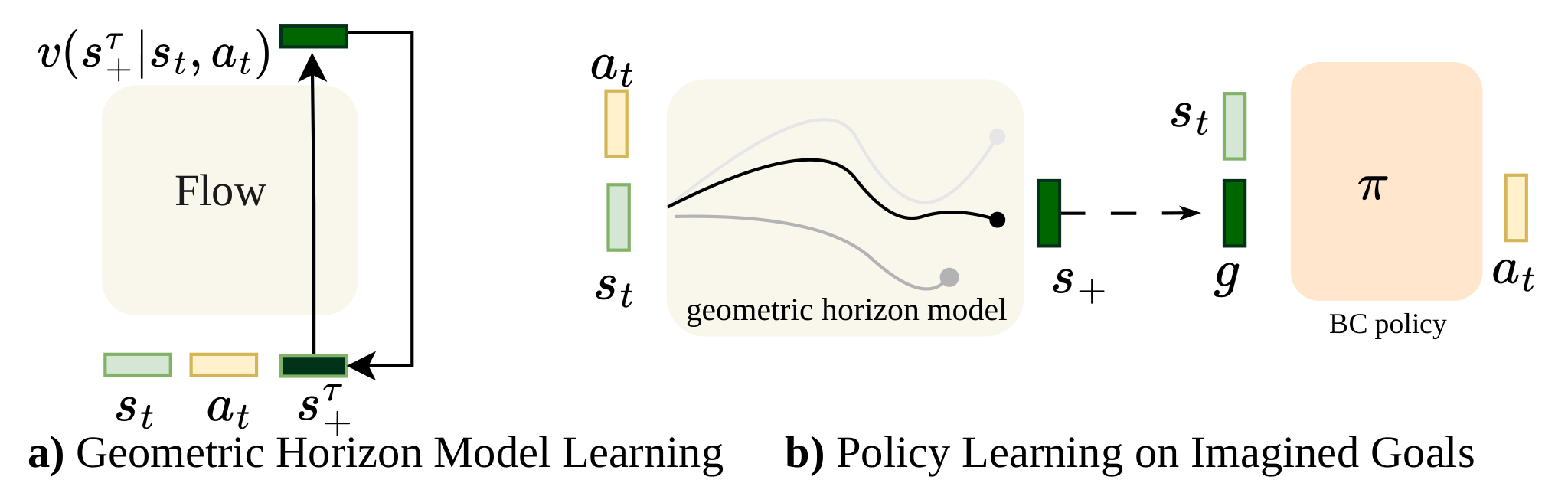
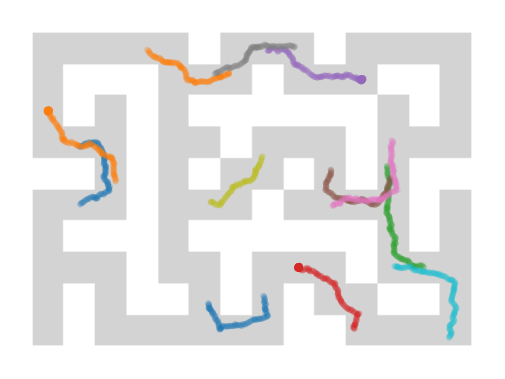
TD-Aug generates goals through a GHM that samples likely future states (s+), conditioned on the current state and action via Mβ(· | s, a). The GHM stitches across trajectories, predicting which outcomes are likely when composing behavior starting from different actions:

Results
Results on OGBench “stitch” tasks. TD-Aug enables BC trained on short trajectories or atomic tasks to generalize to long-horizon, composite goals.
pointmaze-giant-stitch
Training data
GCFBC
(task success 0%, overall success 0%)
TD-Aug (MCHC)
(task success 70%, overall success 54%)
puzzle-4x4-stitch
Training data
GCFBC
(task success 0%, overall success 0%)
TD-Aug (MCHC)
(task success 34%, overall success 40%)
cube-triple-stitch
Training data
GCFBC
(task success 0%, overall success 20%)
TD-Aug (MCHC)
(task success 25%, overall success 31%)
Seed-0 demonstrations for each policy pair. Success rates average three checkpoints per seed, then three seeds.
Quantitative Results
| pointmaze | GCFBC | + Cluster-Aug | + Dyn-Aug | + MC-Aug | + TD-Aug2 | + TD-Aug | GCIQL | QRL | CRL | HIQL |
|---|---|---|---|---|---|---|---|---|---|---|
| pointmaze-medium-stitch | 55 ± 10 | 89 ± 5 | 94 ± 6 | 70 ± 2 | 96 ± 1 | 99 ± 0 | 74 ± 1 | 88 ± 5 | 4 ± 2 | 71 ± 8 |
| pointmaze-large-stitch | 26 ± 6 | 62 ± 8 | 51 ± 10 | 28 ± 17 | 40 ± 3 | 97 ± 3 | 40 ± 1 | 89 ± 15 | 0 ± 0 | 18 ± 4 |
| pointmaze-giant-stitch | 0 ± 0 | 3 ± 6 | 0 ± 0 | 0 ± 0 | 0 ± 0 | 54 ± 17 | 0 ± 0 | 54 ± 9 | 0 ± 0 | 0 ± 0 |
| pointmaze-teleport-stitch | 44 ± 7 | 47 ± 2 | 40 ± 7 | 48 ± 3 | 45 ± 4 | 66 ± 3 | 27 ± 1 | 2 ± 4 | 10 ± 5 | 30 ± 3 |
| Average | 31 | 50 | 46 | 37 | 45 | 79 | 35 | 58 | 4 | 30 |
| visual antmaze | AE-GCFBC | + MC-Aug | + TD-Aug2 | + TD-Aug | GCBC | GCIQL | QRL | CRL | HIQL |
|---|---|---|---|---|---|---|---|---|---|
| visual-antmaze-medium-stitch | 45 ± 4 | 60 ± 2 | 56 ± 1 | 84 ± 7 | 69 ± 4 | 9 ± 0 | 0 ± 0 | 82 ± 2 | 92 ± 1 |
| visual-antmaze-large-stitch | 12 ± 1 | 19 ± 1 | 9 ± 0 | 28 ± 1 | 21 ± 6 | 1 ± 0 | 1 ± 0 | 29 ± 6 | 46 ± 2 |
| Average | 29 | 40 | 33 | 56 | 45 | 5 | 1 | 56 | 69 |
| Environment | GCFBC | + TD-Aug2 | + TD-Aug | GCIQL | HIQL | |
|---|---|---|---|---|---|---|
| play | stitch | stitch | stitch | stitch | stitch | |
| cube-double | 75 ± 1 | 20 ± 0 | 78 ± 2 | 84 ± 0 | 63 ± 1 | 6 ± 2 |
| cube-triple | 35 ± 5 | 20 ± 0 | 36 ± 5 | 31 ± 2 | 8 ± 2 | 0 ± 0 |
| puzzle-4x4 | 23 ± 2 | 0 ± 0 | 18 ± 0 | 40 ± 2 | 16 ± 5 | 0 ± 0 |
| Average | 44 | 13 | 44 | 52 | 29 | 2 |
Mean ± standard deviation over 3 seeds, after averaging the last 3 checkpoints within each seed. TD-Aug2 uses TD2-β; TD-Aug uses MCHC-β. Bold highlights the best BC augmentation and the best method overall on stitching datasets.